Erika’s story: finding purpose after glioblastoma

Erika’s story: finding purpose after glioblastoma
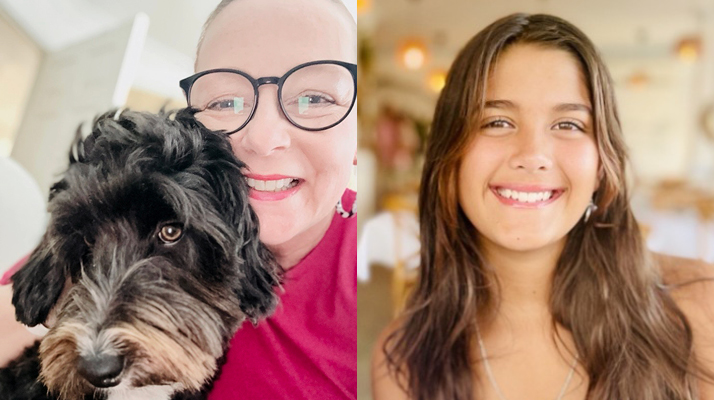
Erika Butler’s life and career changed completely after a diagnosis of glioblastoma.
With support from friends, community and LHH by her side, she found a new way forward – using her experience to advocate, mentor and give others hope. Here’s Erika’s story:
The day everything changed
When Erika Butler woke up in an ambulance, she had no idea what had happened.
“I woke up with a paramedic on one side and a police officer on the other,” she says. “They thought I was drunk.”
It was July 3, 2023. Erika had veered off the road and driven into a house after experiencing symptoms of something far more serious - a CT scan revealed cancer. Three days later, after surgery, she learned it was glioblastoma: one of the most aggressive forms of brain cancer.
“Most people die within the first year,” she says. “And here I am.”
Before her diagnosis, Erika had built a 20-year career at Mary Kay Cosmetics, working in global e-commerce and CRM, leading teams and earning the company’s Go Give Award: recognition for living the “golden rule” through generosity, leadership and service to others.
Choosing to keep moving forward
Even after her diagnosis, Erika was determined that cancer would not be the thing that ended her career.
“I was in the hospital. I had just been diagnosed with terminal cancer, and I said, ‘I’m going back to work,’” she says. “I didn’t want cancer to dictate the end of my career. I wanted to have some control over how my career ended.”
After 13 months of medical leave, while still undergoing chemotherapy and feeling seriously unwell, Erika returned to work. She reached her 20-year milestone. Then, eight and a half months later, she was laid off.
“It was tragic and it was heartbreaking,” she says. “But you have to get up and you have to keep going. I just knew I had more to give.”
Finding support that understood the whole person
Through LHH, Erika was connected with a consultant who took the time to understand not only her career, but her cancer journey too. That made all the difference.
“What my consultant was able to help me do is rebrand myself,” Erika says. “They heard me. They knew I was a cancer survivor, and they connected me with someone who also had experience with cancer. It was beautiful.”
Erika was not looking for another corporate role. She wanted to shape a new identity around the work that mattered most to her now: advocacy, mentorship and awareness for glioblastoma.
“I said, ‘What I need is rebranding. I need rebranding as an advocate, as a mentor, as someone who’s going to work with nonprofits to raise awareness in the brain cancer space.’ And they said, ‘We got you.’”
A new identity: advocate, mentor, storyteller
Together, Erika and her LHH consultant repositioned her experience around three clear pillars: advocacy, mentorship and awareness. They helped translate the leadership skills she had built at Mary Kay – building trust, supporting people, communicating clearly and living the “go give” ethos – into value for nonprofits and patient communities.
“I do a lot of advocacy work,” she says. “I’ve been to Washington DC to meet with members of Congress to advocate for more brain cancer funding. I do mentoring for the newly diagnosed, because I don’t want them to feel like this is a death sentence. They need to see hope.”
Learning again, with purpose
LHH’s Career Studio resources also helped Erika build practical skills for this next chapter. Through LinkedIn Learning, she took courses in content creation and new digital tools, collecting certificates along the way.
“I wasn’t taking classes for 20 years,” she says. “I was exceptionally good in my space, but I needed to learn content creation. Having that access to LinkedIn Learning was really awesome. I just kept taking classes and taking classes.”
With her consultant’s support, Erika updated her LinkedIn profile, resume and personal branding so organizations could see her not only as a former e-commerce executive, but as an advocate, mentor and content partner with lived experience.
Making hope visible for others
Today, she works with nonprofits, creates content, supports newly diagnosed patients and continues to raise awareness of a disease many people have never heard of.
“One of the reasons I tell my story is because it took me two weeks to pronounce glioblastoma when I was first diagnosed,” Erika says. “Funding is exceptionally minimal. Treatment options are minimal. The more I tell my story, the more likely there will be funding, and that helps the people who come after me.”
Her story is one of courage, but also of support: from her “girlfriend tribe,” from the people who showed up when she asked for help, and from an LHH consultant who helped her turn a painful transition into purposeful work.
Living for today
Her advice to others facing change is simple.
“Take all of the help that is given,” she says. “Don’t turn down any help. Whether it’s from a friend or from LHH, take it all.”
And above all: “Take the trip. Say yes to dinner with your friends. You’ve got to live for today.”
To learn more about glioblastoma and ways you can support research, visit Glioblastoma Research Organisation or The National Brain Tumour Society
Hear Erika’s full story in conversation with LHH’s Gary Danoff on the podcast: What happens now? From high achiever to advocate - Episode 36
For more about help with career transitions, visit LHH’s dedicated page: Outplacement services
Related News and Research