
Harnessing Uncertainty | The Change Load Equation
Employees aren't resisting change, they're exhausted by it
As an organizational change leader, I have spent the last few years absorbing research, client discussions, and real-world experiences about change fatigue. Organizational ambition, strategic pivots, AI, and employee sentiment are increasingly at odds, yet the conversation rarely moves beyond diagnosing fatigue. The more important question is: how do we understand and address what is causing it? The Change Load equation helps identify and adjust the pressures creating fatigue.
Transformation Has Changed
Traditional change management was built for a world in which organizations could stabilize between disruptions. Today, economic volatility, tech acceleration, shifting skills, and evolving workforce expectations create continuous change with little opportunity to reset. Leaders may manage a coherent portfolio of strategic initiatives. Individuals experience the cumulative impact through new systems, processes, priorities, and expectations. The pressure does not come from a single change, but the accumulation.
We define this accumulated pressure as Change Load. While Change Fatigue is widely recognized, what creates it is less understood. Managing Change Load helps organizations reduce fatigue while protecting performance, trust, and capacity.
What Is Change Load?
Change Load is the cumulative burden individuals experience from multiple competing demands. Managing it starts with understanding the four levers: volume, velocity, complexity, and emotional cost. Leaders can adjust each lever to bring the overall load to a manageable level.
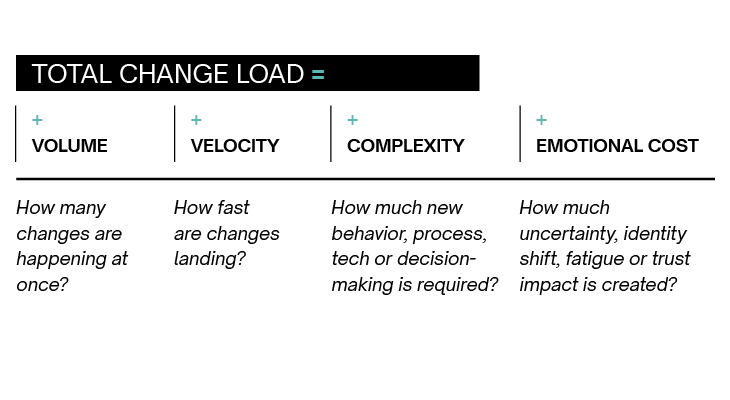
Volume is the number of changes occurring simultaneously, like reorganizations, technology deployments, and process redesigns. Ask yourself, "What can we stop, delay, simplify, or combine before asking people to take on something new?"
- Sequence initiatives. Delay lower-priority projects until critical changes are established.
- Establish a change portfolio review. Regularly assess active initiatives through clear governance.
- Rebalance work when adding activity. For every new process, meeting, or initiative, identify something to pause, automate, offshore, or stop.
- Consolidate communications and activities. Combine multiple launches, training, or messages into a single employee experience.
Harnessing Uncertainty | The Change Load Equation
Employees aren't resisting change, they're exhausted by it
- Protect capacity during peak business periods. Avoid major transformations during annual planning cycles, seasonal spikes, or critical operational periods.
- Create change saturation heat maps. Identify teams experiencing multiple overlapping initiatives and adjust plans for those groups accordingly.
Velocity. The speed at which new changes arrive. Before introducing new transformation efforts, consider whether employees have time to absorb the current change and how frequently priorities are shifting. Ask yourself, "Are we moving at a pace people can realistically absorb, or simply at a pace we would like to achieve?"
- Allow time for readjustment between major changes. Let people learn and normalize new ways of working before introducing the next shift.
- Stabilize decision-making. Avoid repeatedly revisiting decisions unless genuinely necessary.
- Use phased rollouts. Introduce change progressively rather than expecting organization-wide adoption overnight.
- Slow communication frequency when appropriate. Fewer, clearer updates often outperform daily updates that create noise.
- Measure adoption and acclimation before accelerating. Move on to the next milestone or step only after the current change is gaining traction.
Complexity. The amount of new thinking, behavior, skill-building, or decision-making a change requires. It can arise from introducing a new operating model, adopting new technology, shifting planning practices, or shifting decision governance. Ask yourself: “Where are we asking people to think, behave, learn, and decide differently at the same time?”
- Break large transformations into smaller behavioral shifts. Make expectations specific and achievable.
- Provide decision guardrails. Help employees understand boundaries instead of forcing them to navigate uncertainty alone.
- Focus training on critical actions rather than features. Teach people what they must do differently, not all system capability.
- Increase coaching. Managers can help translate abstract change into practical day-to-day expectations.
- Remove unnecessary complexity elsewhere. Simplify reporting, governance, or approval processes while people learn new ways of working.
Emotional Cost is often the least visible but most significant factor. It can stem from job uncertainty, fatigue, role ambiguity, or reduced autonomy and confidence. Ask yourself, "What concerns, uncertainties, or fears are people experiencing that we have not addressed openly?"
- Visibly acknowledge uncertainty. People often trust honest leaders more than leaders who pretend certainty exists.
Harnessing Uncertainty | The Change Load Equation
Employees aren't resisting change, they're exhausted by it
- Explain trade-offs and decisions transparently. Clear reasoning reduces speculation and rumors.
- Create opportunities for employee voice. Listen using surveys, focus groups, and manager conversations; make two-way communication a priority.
- Provide clarity around roles, expectations, and future opportunities. Reducing ambiguity often reduces anxiety.
- Demonstrate responsiveness through visible action. Nothing restores trust faster than evidence that your feedback matters.
- Enlist teams in designing solutions. Co-creation builds ownership and gives employees a meaningful role in driving change.
Understanding and adjusting these levers helps relieve Change Load and build organizational resilience. Not all change is harmful; at manageable levels, it can strengthen adaptability.
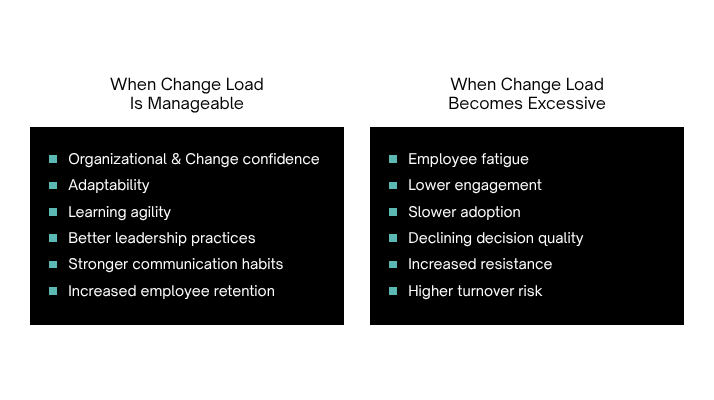
Every transformation places demands on people. Leaders can influence how those demands are experienced. By managing the four drivers of Change Load, leaders create the conditions for greater confidence, adaptability, and sustained performance. The goal is not to eliminate change, but prevent the unmanaged accumulation and make Change Load management part of your operating model.

Allison Ruyak
Global Practice Director, Change & Transformation